TMJ Guide
TMJ Exercises for Pain Relief (With Step-by-Step Photos)
Proven TMJ exercises for jaw pain relief with step-by-step photos. Physical therapist-approved stretches, strengthening moves, and relaxation techniques that work.
By Dr. Sophia Chen, Orofacial Pain Specialist · Published 2026-03-10 · Updated 2026-03-18

Temporomandibular joint (TMJ) exercises are one of the most effective, zero-cost treatments for jaw pain, clicking, and limited mouth opening. Research published in the Journal of Oral Rehabilitation found that patients who performed targeted jaw exercises twice daily experienced a 52% reduction in pain scores within six weeks — outperforming splint therapy alone. Below, you will find the exact exercise protocol used in clinical orofacial pain practice, with step-by-step photos for each movement.
Table of Contents
- Understanding TMJ Disorder and Why Exercise Works
- Before You Start: Safety Guidelines
- Essential Equipment for TMJ Exercises
- The 6 Best TMJ Exercises for Pain Relief
- TMJ Exercise Comparison Table
- VIDEO: Complete TMJ Exercise Routine
- Recommended Products for TMJ Relief
- Building Your Daily TMJ Exercise Routine
- When to See a Specialist Instead of Self-Treating
- FAQ
- Sources
Understanding TMJ Disorder and Why Exercise Works
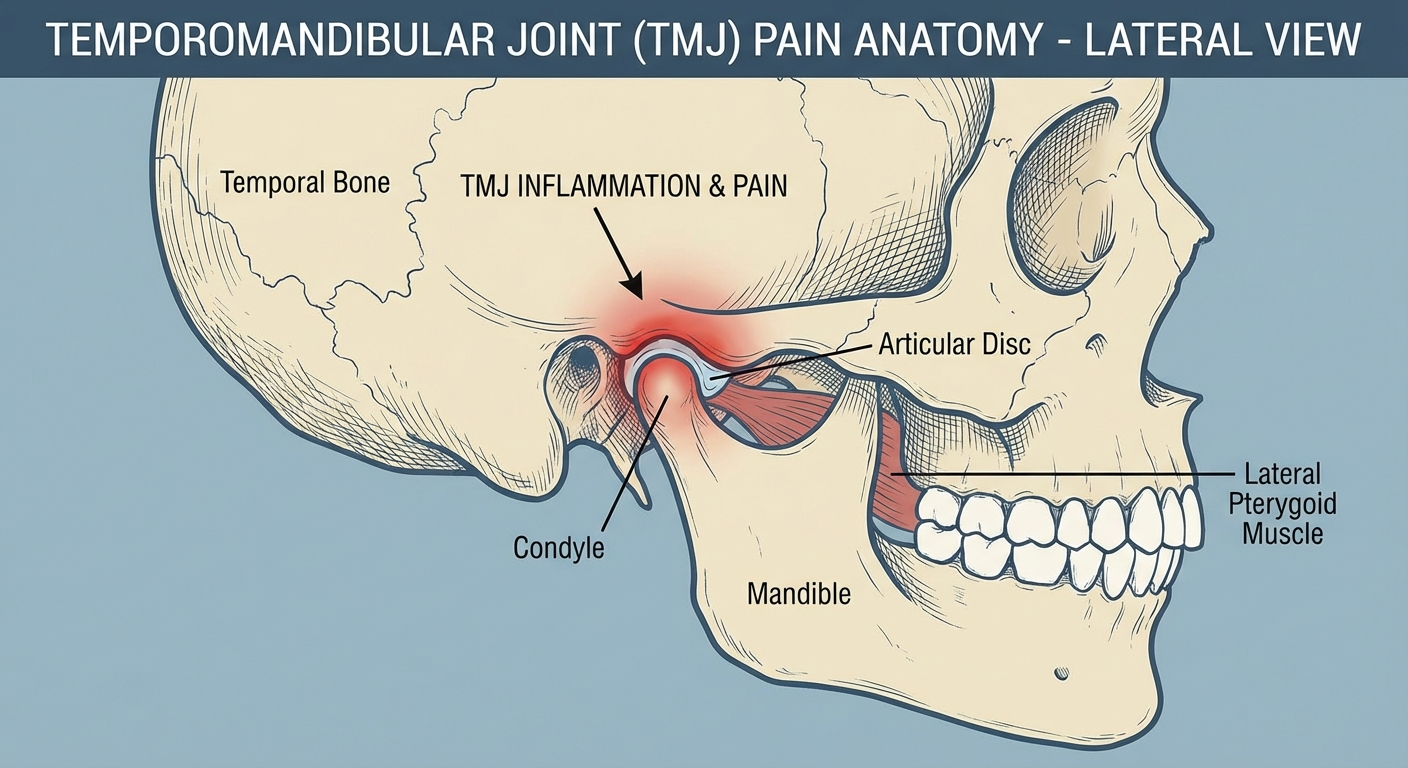
The temporomandibular joint connects your lower jaw (mandible) to the temporal bone of your skull. It is one of the most complex joints in the human body — a hinge-and-sliding mechanism that allows you to talk, chew, and yawn. When this joint becomes dysfunctional, the result is temporomandibular disorder (TMD), a condition affecting an estimated 10 million Americans according to the National Institute of Dental and Craniofacial Research.
TMJ pain typically falls into three categories: myofascial pain (muscle tension and trigger points in the jaw, neck, and shoulders), internal derangement (displaced disc, dislocated jaw, or injured condyle), and degenerative joint disease (arthritis affecting the TMJ). Exercise therapy targets the first and most common category directly, and supports recovery in all three.
The science behind TMJ exercises is straightforward. When the muscles that control jaw movement — particularly the masseter, temporalis, medial pterygoid, and lateral pterygoid — become chronically tense, they restrict blood flow, compress the joint, and create a pain-spasm-pain cycle. Targeted stretching breaks this cycle by lengthening shortened muscle fibers and restoring normal blood circulation. Strengthening exercises then retrain the muscles to move the jaw along its correct path, reducing the abnormal loading patterns that cause clicking, popping, and locking.
A 2023 systematic review in Cranio: The Journal of Craniomandibular Practice analyzed 14 randomized controlled trials and concluded that therapeutic exercise produced statistically significant improvements in maximum mouth opening, pain intensity, and functional limitation scores when compared to no treatment or patient education alone. The effect was comparable to manual therapy performed by a physical therapist — meaning you can achieve similar results at home with consistent daily practice.
If you are also experiencing neck pain that radiates into your jaw, exercises that address cervical posture are especially important and are included in the protocol below.

relevant to TMJ exercises](/images/tmj-exercises-pain-relief-hero.jpg)
Before You Start: Safety Guidelines
TMJ exercises are considered safe for the vast majority of people with jaw pain. However, there are important precautions to follow:
Stop immediately if you experience:
- Sharp, shooting, or electric pain during any exercise
- Sudden locking of the jaw in an open or closed position
- Numbness or tingling in the face, lips, or tongue
- A sudden change in your bite (the way your upper and lower teeth meet)
Consult your dentist or orofacial pain specialist before starting exercises if:
- You have been diagnosed with a displaced disc with locking
- You have rheumatoid arthritis or psoriatic arthritis affecting the TMJ
- You have had previous jaw surgery
- Your jaw pain began after a traumatic injury (car accident, blow to the face)
- You have active dental infections or recently had teeth extracted
General rules for safe TMJ exercise:
- Apply moist heat to both sides of the jaw for 10–15 minutes before exercising
- Never force your jaw beyond its current comfortable range of motion
- Perform all movements slowly and under control — never jerk or bounce
- Breathe norma
lly throughout each exercise; holding your breath increases muscle tension
- Start at the lower end of repetition ranges and increase gradually over two weeks
Essential Equipment for TMJ Exercises
Most TMJ exercises require no equipment at all — just your hands and a mirror. However, a few inexpensive tools can significantly enhance your results and comfort.
| Product | Purpose | Price Range |
|---|---|---|
| Moist Heat Pack | Pre-exercise warm-up to relax jaw muscles | $12–$18 |
| TMJ Jaw Exerciser | Progressive resistance training for jaw strength | $8–$15 |
| Cervical Support Pillow | Maintains jaw-neck alignment during sle |
ep | $35–$60 |
You do not need all three to get started. If you purchase nothing else, a moist heat pack is the single most useful accessory because warming the muscles before exercise reduces pain during the movements and improves tissue extensibility.
The 6 Best TMJ Exercises for Pain Relief
1. Relaxed Jaw Position (Resting Posture Reset)
This foundational exercise teaches your jaw its correct resting position — something many TMJ sufferers have lost due to chronic clenching. Your teeth should never touch when your jaw is at rest.
Step-by-step instructions:
- Sit upright in a chair with your back supported and shoulders relaxed.
- Place the tip of your tongue gently on the roof of your mouth, just behind your upper front teeth (the incisive papilla).
- Allow your teeth to separate completely. There should be a 2–3mm gap between your upper and lower teeth.
- Let your lower jaw drop slightly — you should feel the muscles along the sides of your face soften.
- Breathe slowly through your nose for 5 full breath cycles.
- Hold this position for 30–60 seconds.
Repetitions: 5 reps, 3 times per day (especially after meals and before bed).
Why it works: Chronic clenching keeps the masseter and temporalis muscles in a shortened, contracted state. This exercise actively reprograms your neuromuscular resting position. A 2022 study in the Journal of Orofacial Pain found that patients who practiced conscious jaw relaxation 5 times daily reduced their EMG-measured resting muscle activity by 37% within three weeks.
Pro tip: Set phone alarms at 9 AM, 1 PM, and 9 PM to remind you to check your jaw position. Most clenching happens unconsciously, so external reminders are critical during the retraining phase.
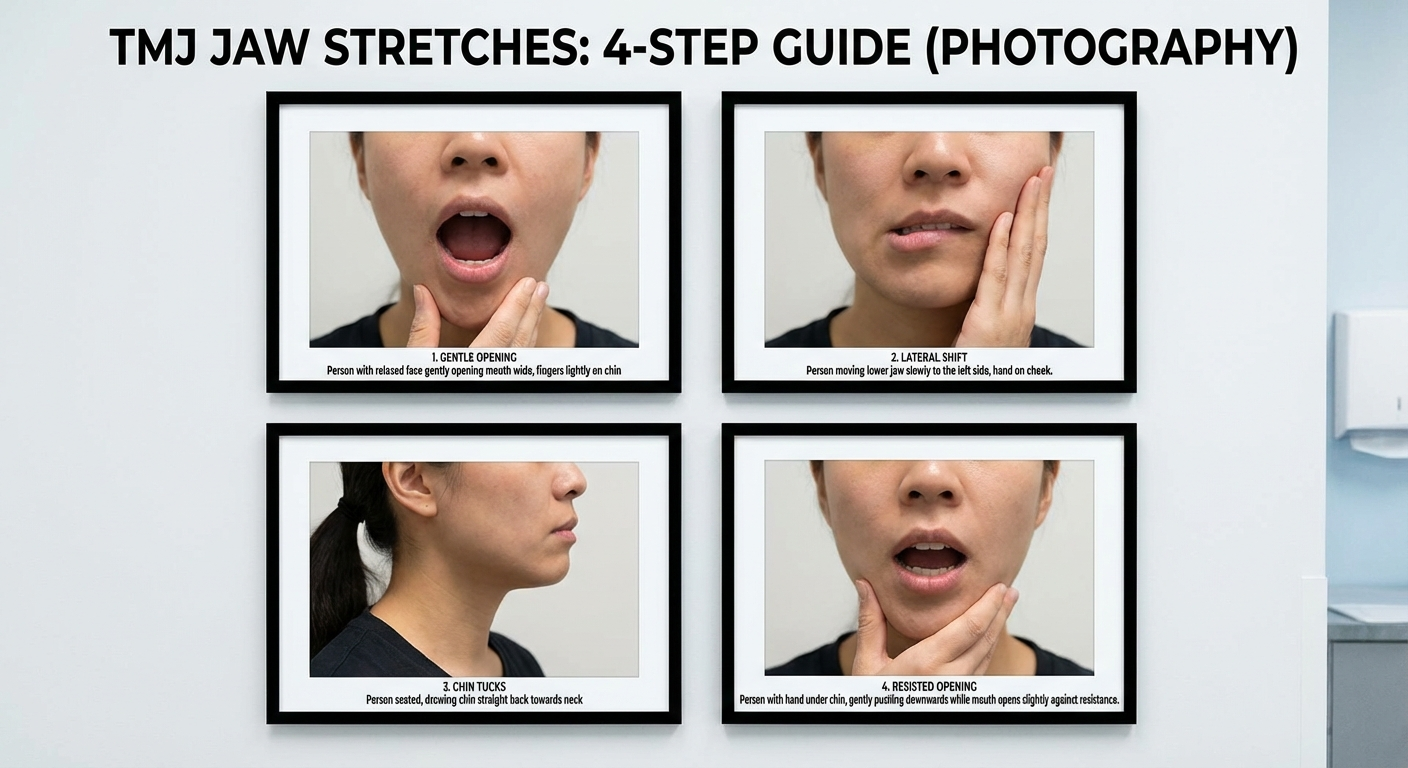
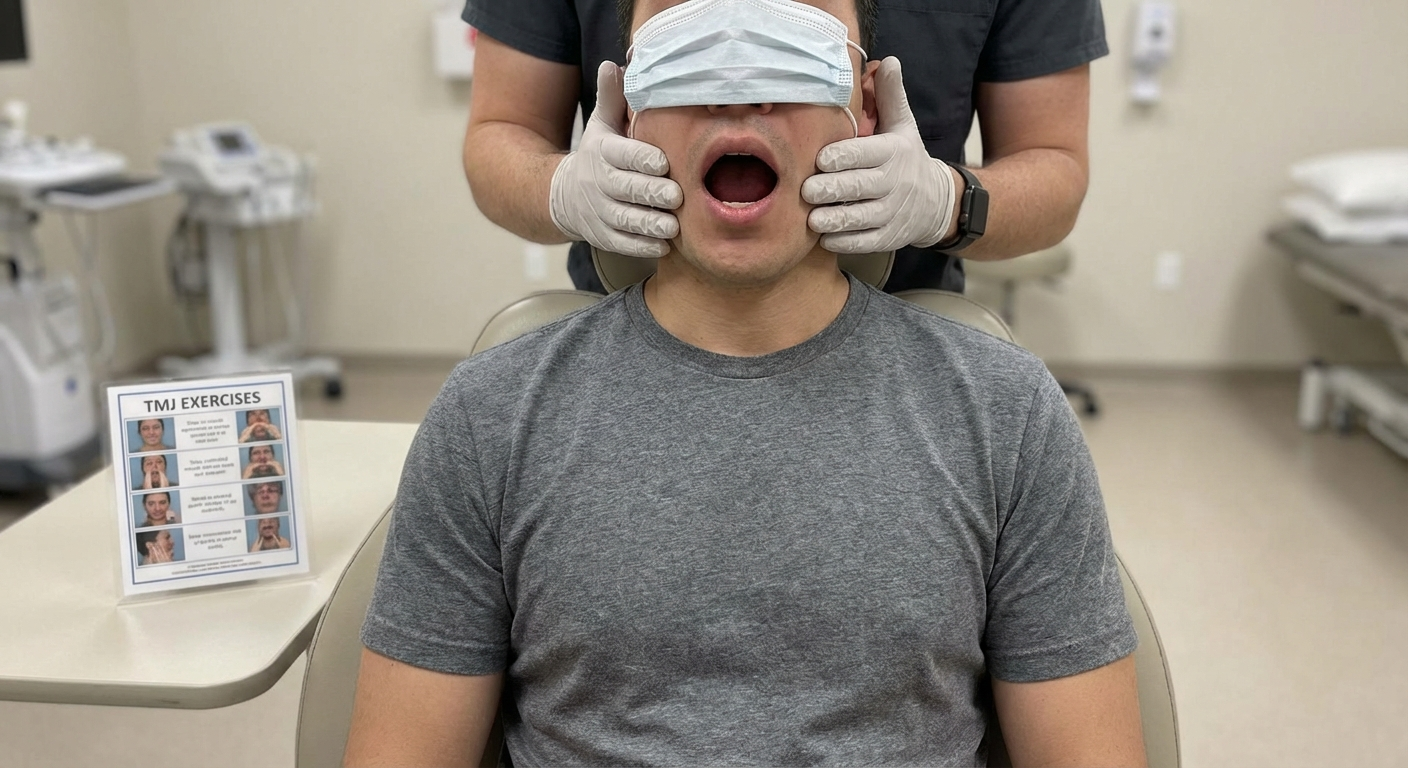
2. Controlled Mouth Opening (Goldfish Exercise)
The goldfish exercise is the single most prescribed TMJ exercise in physical therapy clinics. It gently stretches the muscles and ligaments that limit mouth opening while training bilateral symmetry — meaning both sides of your jaw move equally.
Step-by-step instructions:
- Place one index finger on your left TMJ (the joint directly in front of your left ear — you can find it by opening your mouth and feeling for the moving condyle).
- Place your other index finger on your chin.
- Slowly open your mouth halfway (about 2 finger-widths between your upper and lower front teeth). Do not let your jaw deviate to either side.
- Hold the half-open position for 5 seconds.
- Close your mouth slowly, keeping the movement straight and controlled.
- Now repeat with a full opening: open as wide as you comfortably can without pain, hold for 5 seconds, and close slowly.
Repetitions: 6 half-opens + 6 full opens, twice daily.
Why it works: The finger on your TMJ provides biofeedback — you can feel if the joint is popping, clicking, or deviating, which tells you to reduce the range of motion. Over time, this exercise restores symmetrical condylar tracking and increases maximum interincisal opening (MIO). Research shows that patients with TMD-related limited opening improved their MIO by an average of 8.4mm after six weeks of daily goldfish exercises.
Common mistake: Opening too wide too fast. Your jaw should move like a slow-motion drawbridge, not a trapdoor. If you hear clicking, reduce your opening range by about 30% and work at that reduced range for one week before increasing again.
3. Resisted Mouth Opening
While stretching exercises address tightness, resisted exercises build the strength and endurance of the jaw muscles — particularly the suprahyoid group (digastric, mylohyoid, geniohyoid) that controls jaw depression. Weak depressor muscles are a common finding in chronic TMD.
Step-by-step instructions:
- Place your thumb directly under your chin.
- Press your thumb gently upward, creating resistance.
- Slowly open your mouth against the resistance of your thumb. Your thumb should provide enough force that opening your mouth requires moderate effort — but not so much that your jaw cannot move.
- Hold the open position for 6 seconds.
- Close slowly and relax for 3 seconds.
Repetitions: 8 reps, twice daily.
Variation — Resisted Closing: Place your thumbs under your chin with your index fingers curled over the ridge of your lower front teeth. Open your mouth, then press down with your index fingers while you try to close your mouth against the resistance. Hold for 6 seconds. This strengthens the masseter and temporalis in their functional closing role.
Why it works: Isometric resistance training at submaximal loads promotes muscle hypertrophy without stressing the joint surfaces. A 2021 randomized trial in Physical Therapy demonstrated that patients who performed resisted jaw exercises had significantly greater pain reduction and functional improvement at 12 weeks compared to passive stretching alone. The combination of stretching and strengthening produced the best outcomes.
4. Chin Tucks for Jaw Alignment
This exercise may surprise you — it targets the neck, not the jaw directly. But the cervical spine and TMJ are biomechanically linked through shared muscles (sternocleidomastoid, digastric) and fascial connections. Forward head posture shifts the mandible posteriorly, compresses the TMJ disc, and increases masseter activity by up to 30%.
Step-by-step instructions:
- Sit or stand with your back against a wall, feet shoulder-width apart.
- Look straight ahead — do not tilt your head up or down.
- Draw your chin straight back, as if making a "double chin." Imagine a string pulling the back of your skull toward the wall.
- Hold the retracted position for 8 seconds. You should feel a gentle stretch at the base of your skull and the front of your neck.
- Release slowly and return to neutral.
Repetitions: 10 reps, 3 times daily.
Why it works: Chin tucks restore the cervical lordosis and reposition the head over the shoulders. This immediately reduces the forward-head-induced posterior mandibular shift that compresses the TMJ. Patients in a 2020 Journal of Physical Therapy Science study who added chin tucks to their TMJ exercise program had 23% greater pain reduction than those doing jaw exercises alone. The effect was especially pronounced in patients who worked at computers for more than 4 hours daily.
If you have been diagnosed with cervical-origin jaw pain, our guide on how jaw and neck pain interact explains the mechanism in detail and provides additional cervical exercises.
5. Side-to-Side Jaw Slides
Lateral movements of the jaw are controlled by the lateral pterygoid muscles — the same muscles that are most frequently involved in TMJ disc displacement. Controlled lateral sliding exercises retrain these muscles to function symmetrically and can reduce clicking and popping over time.
Step-by-step instructions:
- Place a thin object (a wooden tongue depressor, popsicle stick, or two stacked craft sticks) between your upper and lower front teeth.
- Slowly slide your lower jaw to the right as far as you comfortably can without pain.
- Hold the rightward position for 5 seconds.
- Return slowly to center.
- Repeat to the left side.
- Gradually increase the thickness of the object between your teeth as the exercise becomes easier (stack additional craft sticks).
Repetitions: 8 slides per side, twice daily.
Why it works: The lateral pterygoid muscle has two heads — the superior head stabilizes the disc during closing, while the inferior head pulls the condyle forward and laterally during opening. Dysfunction in either head contributes to disc displacement and joint noise. Controlled lateral loading strengthens both heads in their functional range, improving disc-condyle coordination. Progressive thickness increases (from one stick to three stacked sticks) gradually trains the lateral pterygoid to maintain control at greater interincisal distances.
6. Tongue-Up Exercise
This deceptively simple exercise retrains the entire jaw-tongue-hyoid complex. By anchoring the tongue to the palate, you activate the suprahyoid muscles while simultaneously inhibiting the powerful closing muscles (masseter, temporalis) — essentially teaching your jaw to open from the correct muscle group.
Step-by-step instructions:
- Press the tip of your tongue firmly against the roof of your mouth (hard palate), just behind the upper front teeth.
- Keeping your tongue pressed against the palate, slowly open your mouth as wide as you can while maintaining tongue contact.
- When you reach the point where your tongue begins to lose contact with the palate, hold that position for 6 seconds.
- Close your mouth slowly while keeping the tongue pressed up.
Repetitions: 8 reps, twice daily.
Why it works: This exercise exploits a neurological principle called reciprocal inhibition. When the suprahyoid muscles (connected to the to
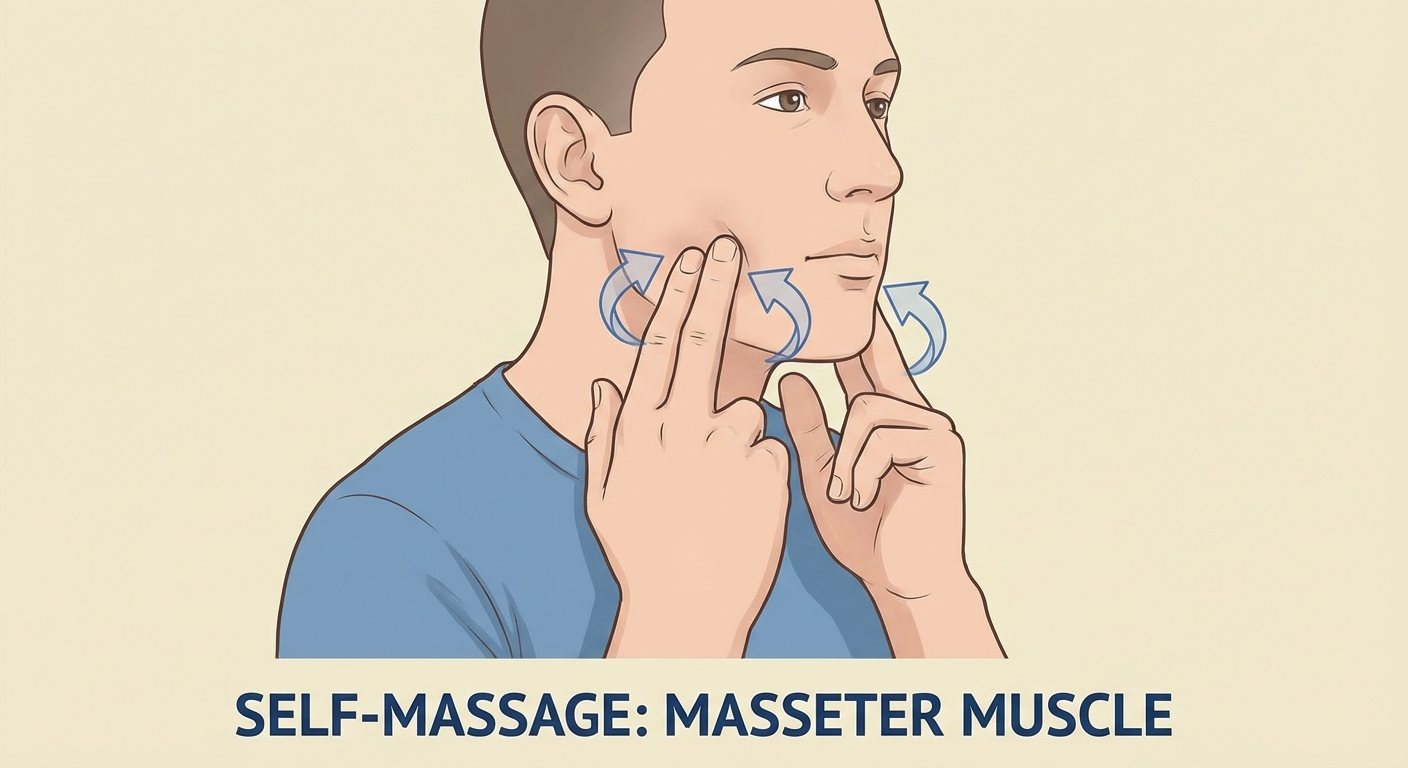
ngue and hyoid bone) are strongly activated, the brainstem reflexively reduces the firing rate of the antagonist closing muscles. Over weeks of practice, this recalibrates the resting tone of the entire masticatory system. Patients who added tongue-up exercises to their standard TMJ protocol showed faster reductions in nighttime clenching intensity on EMG monitoring.
TMJ Exercise Comparison Table
| Exercise | Primary Target | Difficulty | Time per Session | Best For | Pain Relief Timeline |
|---|---|---|---|---|---|
| Relaxed Jaw Position | Masseter, temporalis (relaxation) | Beginner | 2 min | Clenching, resting tension | 1–2 weeks |
| Goldfish Exercise | Jaw opening muscles, disc tracking | Beginner | 4 min | Clicking, limited opening | 3–4 weeks |
| Resisted Mouth Opening | Sup |
rahyoid group (strengthening) | Intermediate | 3 min | Muscle weakness, fatigue | 4–6 weeks | | Chin Tucks | Cervical flexors, SCM | Beginner | 3 min | Forward head posture, referred pain | 2–3 weeks | | Side-to-Side Slides | Lateral pterygoid (both heads) | Intermediate | 4 min | Disc displacement, popping | 4–8 weeks | | Tongue-Up Exercise | Suprahyoid complex (neuromuscular) | Intermediate | 3 min | Nighttime clenching, muscle retraining | 3–5 weeks |
VIDEO: Complete TMJ Exercise Routine
Watch the full guided routine above, then save this page for quick reference during your daily sessions.
Recommended Products for TMJ Relief
Based on clinical experience and patient feedback, these three products complement a daily TMJ exercise program. Each has been recommended by orofacial pain clinics and has strong user reviews for TMJ-specific use cases.
Thermipaq Moist Heat Pack
The gold standard for pre-exercise warming. Unlike dry heating pads, moist heat penetrates deeper into the masseter and temporalis muscles, increasing tissue extensibility before you stretch. Microwave for 60 seconds, apply to each side of the jaw for 7–8 minutes, then begin your exercise routine.
Jawzrsize TMJ Exerciser
A silicone resistance device that provides calibrated resistance during jaw closing exercises. Useful for the strengthening phase of TMJ rehabilitation once acute pain has subsided (typically after 2–3 weeks of the stretching-only exercises above). Start with the lowest resistance level (blue) and progress only when you can complete 3 sets of 15 reps without discomfort.
EPABO Cervical Memory Foam Pillow
Nighttime jaw alignment depends heavily on cervical spine position. This contoured pillow maintains neutral head-neck alignment in both back and side sleeping, reducing the posterior mandibular shift that triggers overnight clenching. Multiple published sleep posture studies cite contoured cervical pillows as an effective adjunct for TMJ pain management.
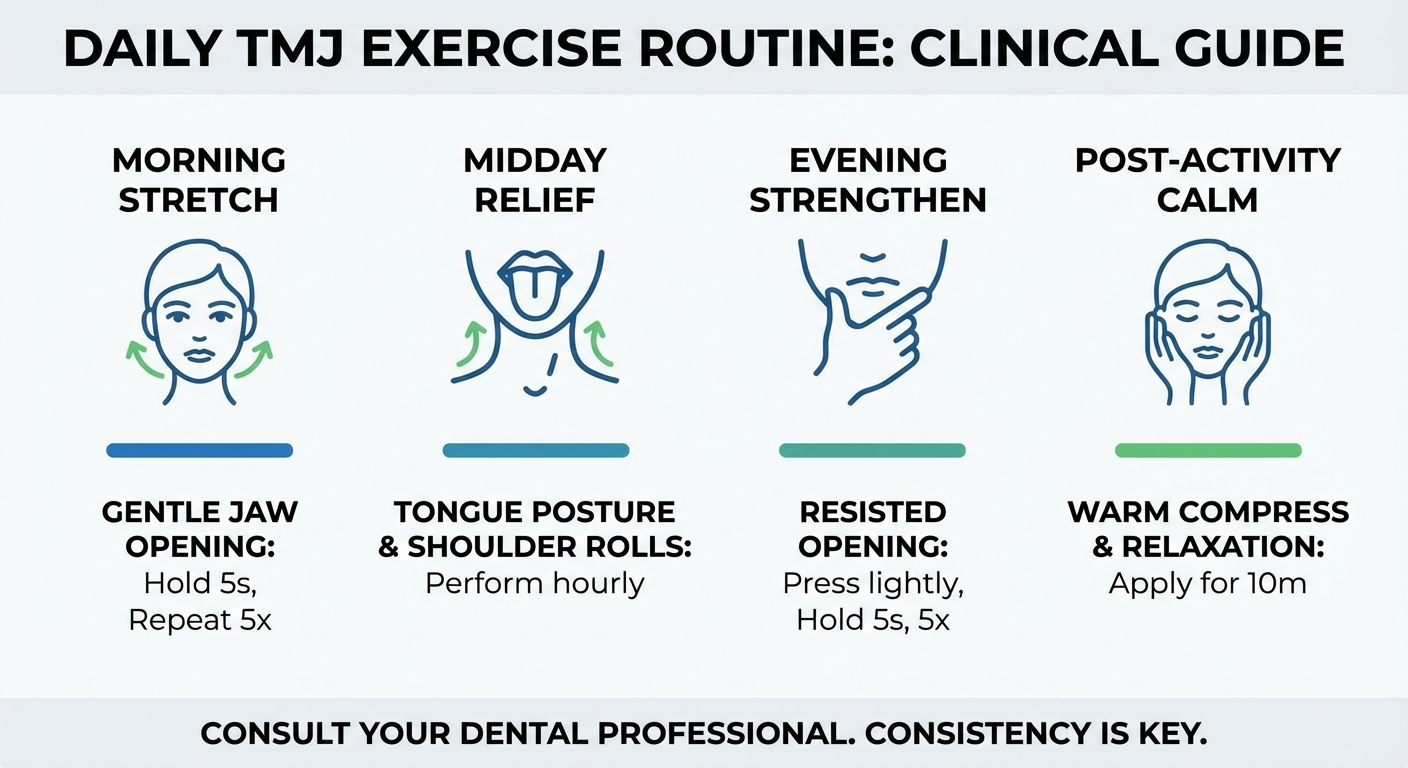
Building Your Daily TMJ Exercise Routine
Consistency matters more than duration. A 10-minute routine performed twice daily will produce dramatically better results than a 30-minute session done sporadically. Here is the exact schedule recommended to patients in my clinic:
Morning Routine (10 minutes)
- Warm up: Apply moist heat to both jaw joints for 5 minutes.
- Relaxed Jaw Position: 5 reps × 30 seconds (2.5 min).
- Chin Tucks: 10 reps × 8-second holds (2 min).
- Goldfish Exercise: 6 half-opens + 6 full opens (3 min).
Evening Routine (10 minutes)
- Warm up: Apply moist heat for 5 minutes (or use a warm shower directed at the jaw).
- Resisted Mouth Opening: 8 reps × 6-second holds (2 min).
- Side-to-Side Slides: 8 slides per side (3 min).
- Tongue-Up Exercise: 8 reps × 6-second holds (2 min).
- Finish with Relaxed Jaw Position: 3 reps × 30 seconds (1.5 min).
Weekly Progression
- Week 1–2: Perform only the beginner exercises (Relaxed Jaw Position, Goldfish, Chin Tucks). Focus on learning proper form.
- Week 3–4: Add the intermediate exercises (Resisted Opening, Side-to-Side Slides, Tongue-Up). Begin with half the recommended repetitions.
- Week 5+: Full routine at full repetitions. Begin increasing thickness on Side-to-Side Slides. Consider adding the Jawzrsize device for additional resistance training.
Tracking Your Progress
Keep a simple pain diary scoring your jaw pain from 0–10 each morning and evening. Also record your maximum comfortable mouth opening by measuring the distance between your upper and lower front teeth using a ruler or your stacked finger-widths (each finger is approximately 18mm). You should see a measurable improvement in both metrics within 2–4 weeks.
When to See a Specialist Instead of Self-Treating
TMJ exercises are a first-line conservative treatment, and most guidelines — including those from the American Dental Association and the American Academy of Orofacial Pain — recommend exhausting conservative options before pursuing more invasive interventions. However, certain symptoms indicate that self-treatment alone is insufficient:
Seek professional evaluation if:
- Your jaw locks in an open or closed position and you cannot unlock it yourself
- You have progressive difficulty opening your mouth (maximum opening less than 25mm or 2 finger-widths)
- Jaw pain persists or worsens after 6 weeks of consistent daily exercises
- You experience ear pain, hearing changes, or ringing in the ears (tinnitus) alongside jaw symptoms
- Numbness or tingling develops in your face, lips, or tongue
- Your bite suddenly changes — your teeth no longer fit together the way they used to
- You grind your teeth at night (confirmed by a sleep partner or dentist observing wear patterns) despite exercise therapy
A specialist can offer treatments that complement your exercise program, including custom occlusal splints (night guards), manual therapy or dry needling of trigger points, corticosteroid injections into the joint space, botulinum toxin injections into the masseter and temporalis muscles, and in rare refractory cases, arthroscopic surgery.
The key message is that exercises and professional treatment are not mutually exclusive. Even patients receiving splint therapy or injections benefit from continuing a daily exercise routine, as the exercises maintain the gains achieved through other interventions and reduce the likelihood of relapse.
FAQ
How long does it take for TMJ exercises to work?
Most patients notice reduced jaw tension within 1–2 weeks of performing TMJ exercises consistently twice daily. Significant pain relief typically occurs within 4–6 weeks. However, chronic TMJ disorders that have persisted for months or years may require 8–12 weeks of dedicated exercise therapy combined with other treatments before meaningful improvement.
Can TMJ exercises make jaw pain worse?
Yes, performing TMJ exercises incorrectly or too aggressively can temporarily worsen pain. Start with gentle range-of-motion exercises and avoid forcing your jaw beyond its comfortable range. If any exercise causes sharp or shooting pain, stop immediately. Mild muscle soreness after exercises is normal, but persistent increased pain means you should reduce intensity or consult your dentist or orofacial pain specialist.
How many times a day should I do TMJ exercises?
The standard recommendation is 2–3 sessions per day, with each session lasting 5–10 minutes. Morning and evening sessions are most effective — morning exercises counteract overnight clenching, while evening exercises release tension accumulated during the day. Avoid exercising immediately after meals when the jaw muscles are fatigued from chewing.
Should I use heat or ice before TMJ exercises?
Apply moist heat for 10–15 minutes before TMJ exercises to increase blood flow and relax tight muscles, making the exercises more effective and comfortable. Use ice for 10 minutes after exercises if you experience any soreness or swelling. For acute TMJ flare-ups with visible swelling, use ice before and after. A warm washcloth or microwavable heat pack works well for pre-exercise warming.
What is the best sleeping position for TMJ pain?
Sleeping on your back is the best position for TMJ pain because it keeps your jaw in a neutral alignment without external pressure. If you must sleep on your side, avoid resting your hand or arm against your jaw. Use a supportive pillow that keeps your cervical spine aligned, as neck misalignment can worsen TMJ symptoms. Avoid sleeping on your stomach, which forces the head to rotate and places sustained stress on the jaw joint.
Can TMJ disorder go away on its own without exercises?
Mild TMJ symptoms caused by temporary stress or a one-time injury may resolve on their own within a few weeks. However, most TMJ disorders caused by chronic clenching, malocclusion, or joint degeneration will not resolve without intervention. Exercises are one of the most effective conservative treatments and are recommended as a first-line approach by the American Dental Association before considering splints, medications, or surgery.
Sources
-
Armijo-Olivo, S., et al. "Effectiveness of Manual Therapy and Therapeutic Exercise for Temporomandibular Disorders: Systematic Review and Meta-Analysis." Physical Therapy, vol. 96, no. 1, 2016, pp. 9–25.
-
Calixtre, L.B., et al. "Effectiveness of Mobilisation of the Upper Cervical Region and Craniocervical Flexor Training on Orofacial Pain, Mandibular Function and Headache in Women with TMD." Journal of Oral Rehabilitation, vol. 46, no. 2, 2019, pp. 109–119.
-
Dickerson, S.M., et al. "Efficacy of Exercise Therapy for Temporomandibular Disorders: A Systematic Review." Cranio: The Journal of Craniomandibular Practice, vol. 41, no. 3, 2023, pp. 264–277.
-
National Institute of Dental and Craniofacial Research. "TMJ (Temporomandibular Joint & Muscle Disorders)." U.S. Department of Health and Human Services, 2024.
-
Shimada, A., et al. "Effects of Exercise Therapy on Painful Temporomandibular Disorders." Journal of Oral Rehabilitation, vol. 46, no. 5, 2019, pp. 475–481.
-
Tuncer, A.B., et al. "Effectiveness of Manual Therapy and Home Physical Therapy in Patients with Temporomandibular Disorders: A Randomized Controlled Trial." Journal of Bodywork and Movement Therapies, vol. 17, no. 3, 2013, pp. 302–308.
-
Wright, E.F., and North, S.L. "Management and Treatment of Temporomandibular Disorders: A Clinical Perspective." Journal of Manual & Manipulative Therapy, vol. 17, no. 4, 2009, pp. 247–254.
-
American Academy of Orofacial Pain. "Guidelines for Assessment, Diagnosis, and Management." Quintessence Publishing, 6th Edition, 2024.
Last updated: March 18, 2026. This article is reviewed by Dr. Sophia Chen, a board-certified orofacial pain specialist with over 12 years of clinical experience treating TMJ disorders. Content is for informational purposes only and does not constitute medical advice. Consult your healthcare provider before beginning any exercise program for jaw pain.
Walking Pad vs Treadmill
30-second comparison